











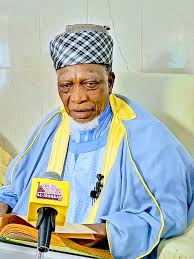

Sheikh Jingir was speaking at a Kano State Government-sponsored mass wedding on August 8 when he reportedly urged Muslims to support another Muslim-Muslim presidential ticket in 2027.
That position, in itself, isn’t outside the bounds of democratic expression. Every Nigerian has the right to support whichever candidate or political arrangement he or she chooses. What is deeply troubling is the religious framing of his argument.
He reportedly described the 2023 election as a religious victory, saying, “When the votes were counted, Allah helped us, and we defeated them.” He also declared, “My vote is for Islam,” and urged his audience to similarly vote for Muslims. He reportedly referred to Christians as “infidels” and suggested that those who could not accept a Muslim-Muslim ticket should leave Nigeria because Muslims, supposedly, constituted the majority.
Such language is irresponsible, dangerous and unacceptable in a country as religiously diverse and historically sensitive as Nigeria.
Sheikh Jingir subsequently had an opportunity to reconsider his words. Instead, in a BBC Hausa interview, he doubled down, saying, “I have absolutely no regrets,” adding that he would continue to advocate a Muslim-Muslim ticket. More revealingly, he said: “I am not campaigning for Bola Tinubu, I am campaigning for my religion.”
That statement captures the problem. Political contests in a constitutional democracy should not be reduced to religious contests. Elections are about competing visions for governing the country, the competence and character of candidates, their policies and their ability to improve the lives of citizens. They should never become a referendum on which religion should defeat another.
Indeed, a Nigerian can support a Muslim-Muslim ticket without believing that Muslims are entitled to political dominance because they constitute a supposed majority. Equally, someone can oppose such a ticket without being anti-Muslim or anti-Islam. The determining consideration should be what best serves Nigeria.
There has also been an important intervention from those who recognise this distinction. One prominent political voice who supports the Muslim-Muslim ticket has nevertheless warned that the religiously supremacist argument used to justify it is dangerous. The point is that a person may support the ticket because of the competence, character, electoral strength or suitability of the candidates, not because they belong to the same religion.
Nigeria is neither a Muslim nor a Christian country. It is a secular, multi-religious state, and its diversity is a strength rather than a weakness.
Another intervention from within the political establishment made an equally important point: religious difference should not create human distance. Nigerians may worship differently, but they remain bound by a common humanity and a common country. Nigeria cannot be secured by one faith defeating another or one ethnic group triumphing over another. There is no victory in destroying the house in which everybody lives.
These are sentiments that should be amplified, not drowned by the increasingly ugly exchange between religious personalities.
We are equally concerned about responses from Christian clerics. Reverend Ezekiel Dachomo and others who have reacted angrily to Jingir must also exercise restraint. Understandably, Christians would be offended by being described in derogatory religious terms. But responding to inflammatory rhetoric with more inflammatory rhetoric only deepens the problem. No religious leader should imagine that he has a licence to use the pulpit or public platforms to insult, demonise or incite followers against people of another faith.
Pastor Paul Enenche’s call for a census to establish whether Christians or Muslims constitute the larger population as a reaction to the controversy also shows how quickly the argument can descend into a contest of religious numbers.
This is happening at a particularly unfortunate time. While some countries are measuring their progress in science and technology, agricultural productivity, medical discoveries, industrial innovation and educational advancement, Nigerians are being invited into another argument over which faith is numerically superior.
Millions of Nigerians are hungry. Young people are struggling to find jobs. Farmers face insecurity. Families are battling the rising cost of food. Hospitals require better equipment and personnel. Schools need improvement. Infrastructure is inadequate. These are the issues that should command the attention of religious leaders and political actors.
What will a Muslim-Muslim or Christian-Christian ticket mean to a hungry Nigerian if it does not deliver justice, security, prosperity, freedom and good governance?
The Kano mass wedding was particularly inappropriate for such rhetoric. Turning it into a platform for religious mobilisation was regrettable. The silence of the governors of Kano, Jigawa and Katsina, who were associated with the event, was also disappointing. Political leaders present at such gatherings have a responsibility to make clear that government-sponsored events belong to all citizens and must not be used to promote religious antagonism.
We also urge President Bola Tinubu and the APC to recognise the danger of allowing religious personalities to speak as though they represent the government or the entire Muslim community. If Sheikh Jingir believes he is helping the administration by campaigning for it through religious mobilisation, he should realise that such rhetoric could instead damage it. Government should be judged by what it does for Nigerians, not by the religious identity of those in power.
More importantly, politicians must stop patronising clerics who engage in divisive rhetoric for political advantage. The relationship between political power and religious influence requires greater responsibility. Politicians who encourage or tolerate inflammatory clerical voices because they believe such voices can deliver votes are ultimately gambling with national cohesion.
Law enforcement agencies should also take this matter seriously. Religious leaders do not have a monopoly on gutter language, nor does clerical status confer immunity from the law. Where public statements cross the legal threshold into incitement, threats or conduct capable of provoking violence, the appropriate authorities should investigate and act. This must apply equally to Muslim and Christian clerics. There should be no selective enforcement.
For too long, some influential religious figures have acted as though they are untouchable. That culture must end. Nigeria’s Constitution does not create a class of citizens who are above accountability simply because they command large congregations or enjoy religious influence.
We, therefore, urge Sheikh Jingir to reconsider his words. We equally urge Christian clerics who have responded in kind to withdraw from the gutter and return to the higher ground expected of people of faith.
Nigeria cannot afford a religious war of words at a time when it desperately needs unity to confront insecurity, hunger, unemployment and economic hardship.
Nigeria first must be the principle that guides us all. We are Muslims and Christians, but above all, we are Nigerians. Democracy can thrive only when citizens see one another as fellow citizens rather than enemies divided by faith. Religious leaders should build bridges, politicians should unite the country, and law enforcement agencies should ensure that nobody mistakes influence for impunity.
The country has enough problems. We should not allow religion to become another weapon with which to tear it apart.