















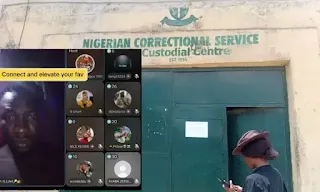

A death row inmate at the Ibara Correctional Centre in Abeokuta, Ogun State, allegedly operated multiple TikTok accounts, hosted livestreams, received monetary gifts, and communicated with people outside prison, raising concerns about security and corruption within Nigeria’s correctional system.
The inmate, Elijah Oyebode, was sentenced to death by hanging in 2019 after an Osun State High Court convicted him of murdering Rofiat Adebisi, a final-year student of Osun State University. According to court records, Oyebode gave conflicting accounts of the crime before denying involvement during trial. The court found him guilty based on medical and other evidence.
Despite being on death row, Oyebode allegedly maintained an active presence on TikTok. One account reportedly reached Level 20 gifting status, allowing him to receive monetary gifts during livestreams. Investigators also linked him to another account allegedly created to impersonate TikTok creator and activist Omolola Awoyele.
Awoyele said she initially believed Oyebode’s claims of innocence and helped seek legal support after confirming through a video call that he was indeed inside prison. However, she later obtained court records and confronted him. “Elijah created an account using my name and uploaded my picture, which meant he could potentially use it to scam people online,” Awoyele said”.
She added: “At first, I did not believe him. I asked if he had WhatsApp because I wanted to confirm his claims through a video call. Through the video call, I confirmed that he was indeed in prison.”
According to Awoyele, Oyebode later admitted his involvement in the crime, leading the lawyer handling his appeal to withdraw from the case. During one of her TikTok livestreams in April 2026, Oyebode allegedly disclosed how inmates access phones and the internet inside prison.
“An individual may be in possession of two to three phones,” he said. “Facebook and TikTok are full of prisoners. They will not disclose their location to anyone. If they do video calls and people see a nice background, they will not know where they are.”
Speaking about his online earnings, he said: “I get a lot of people sending money to me from the internet; only a few are my family. The bet I won last month was ₦85,000.” Oyebode also alleged that correctional officers helped smuggle prohibited items into the facility. She said: “The warders are not the ones selling phones to us. They only get them for us at the tarmac and smuggle them in for us.”
He further claimed: “Even if it is the warder that brought it in for you, if another warder sees it, he will seize it and demand a certain amount from you before you get it back. Because it [phone] is our companion, we will definitely pay for its release.”
On illegal drugs, he alleged: “Warders smuggle drugs in for inmates. The inmate might buy the drugs for about ₦500,000, and the warder who smuggled them in might collect ₦100,000 from them. So, after repackaging and reselling, the inmates can make ₦2 million from the drugs.”
He also claimed: “There are some inmates here who are building hotels outside the prison and always go there for supervision with the aid of the warders while facing the death penalty. The warders take them to their various houses and hotels and bring them back. Some will meet people, especially women, on social media and settle the warders to meet with them.
Reflecting on his experience in prison, Oyebode said: “I will not deceive you; it is no longer a correctional centre. It is corrupting people more.”
Responding to the allegations, Nigerian Correctional Service spokesperson Jane Osuji acknowledged that misconduct by some officers remained a challenge but stressed that the agency does not tolerate corruption. “I cannot sit down here and tell you that it is true or it’s not true because where there are so many individuals, there will be one or two bad eggs in them,” she said. “We want a situation where we can work together so that we can have evidence of this, track it, and get both the inmates and the officers that are enabling this.”
She warned about the risks posed by inmates having unrestricted digital access. She said: “If they can join a live social media platform for fun or monetary value, they can as well do anything from the comfort of their cells. When they are able to organise their criminal activities from behind the walls of the correctional service, then you and I are in for it.”
Osuji added that contraband remained a global correctional challenge. She said: “It is important to state clearly that the smuggling of unauthorised gadgets into prisons is a challenge faced by correctional administrations globally.
She said the service had disciplined more than 1,400 officers for various forms of misconduct and maintained a zero-tolerance policy. She said: “The comptroller-general maintains a zero tolerance for every form of misconduct or corruption involving staff or inmates.” She also appealed to the public: “If inmates continue to receive such assistance without reports being made to the authorities, they may leave correctional facilities worse than when they entered, defeating the purpose of correction and rehabilitation.”
The investigation also questioned TikTok’s moderation systems, noting that the inmate’s account allegedly remained active despite the platform’s large-scale content enforcement efforts. TikTok later requested details of the accounts for an internal review and subsequently announced the removal of millions of videos and thousands of livestreams in Nigeria. However, investigators said Oyebode’s primary account remained active even after the reported enforcement sweep.