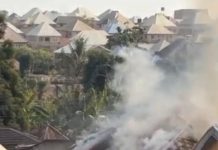














Seated in twos on combined 48-inch desks and chairs, fixing their eyes on their examination questions, the students of Graceland Schools in Dutse Bmuko, Bwari Area Council, Abuja, were soon thrown into panic after a blast from the nearby Istanbul Quarry went off at about 12:30 p.m. on November 25, 2025, shooting a flyrock that punctured the classroom ceiling and wall and disrupted the once-quiet environment.
Four days after the incident, shattered window panes, damaged food packs, a wrecked shelf, two damaged laptops, and books covered in rubble and dust littered the school’s classrooms, housed in a U-shaped, orange-coloured building. The property has a crèche, nursery, primary and secondary schools.

For residents of Dutse Bmuko, a community hosting two quarries, the noise of rock-crushing machines, a heavy cloud of dust, and intermittent rock blasting, often accompanied by deadly flying rocks, are a frequent and normal experience.
However, the November 25 blast was “different” for community members, especially for Graceland Schools, which were forced to shut down following the incident. Several schoolchildren were wounded.

Istanbul Quarry, on its website, prides itself as a company that “adheres to environmental standards and promotes responsible mining operations” and “ensures top-notch production and safety practices”.
The blast
With the permission of Graceland Schools, Peoples Gazette spoke with four pupils who escaped the incident. Some who had bruises are yet to resume their examinations.
“We were writing exams in the class. We heard a very heavy sound because it usually happens, so we sat down,” said Mercy Elijah, a 15-year-old SSS1 student. “The next thing we saw was the roof and dust on our bodies. Some were injured. We were shocked because it was terrible. It is still like I’m dreaming, like imagination.”

A JSS1 student, Bankole Jesulayomi, 12, said, “At first I was shocked. Everywhere became dusty, and everybody ran out, shouting.”
Sofia Linus, a 13-year-old student, recalled how all the pupils “began to scream” after “it (the rock) just crashed into the wall, and there were stones everywhere”. A JSS2 student, Wale Samuel, 12, described the experience as “scary, terrible, and shocking”.

“That very rock was what came in through the wall right above my head, collapsing the wall,” a Graceland Schools teacher, Joan Samuel, who sat in a corner at the time of the blast, told The Gazette, pointing to a flyrock, more than 15 inches long and seven inches wide.
The teacher said that a few seconds after the blast, she felt “the ground was sinking” under her feet because of the devastating impact of the heavy flyrock.

“Ideally, we hear their explosion from time to time whenever they do a dynamite blast from the mine. But that particular day, the blast sounded different,” Ms Samuel said, as she repeatedly pointed to the red chair with a gold-coloured frame in the right corner of the classroom, where she had sat before the wall collapsed.
Agada Emmanuel, another teacher, said, “Immediately we heard the blast from the Istanbul Quarry plant; some seconds later we heard a sound on our roof.”

“Before I could realise what was happening, a big rock had penetrated through the roof, broken this wall, and penetrated through the students’ writing exams.”
According to Mr Emmanuel, staff crawled on their knees through the dust-filled classroom to rescue students.
While Ms Samuel and Mr Emmanuel came out unhurt and have resumed work, their colleague, Irene Igwe, was not so lucky. She sustained a cut to her head.

Istanbul Quarry’s silence despite devastating blast
Days after, Istanbul Quarry has yet to issue an official statement or visit Graceland Schools, where heavy flyrock from its mining activities wreaked both physical and psychological havoc.
The quarry’s giant blue gate, with a white image of a quarry and the inscription ‘Istanbul Concrete Limited’, was shut during a visit to Dutse Bmuko on November 28.

Oluwakemi Ogunwale, who is in charge of the schools’ daily operations, said the management had reported the blast to the Ushafa Police Division in the Bwari Area Council on November 26. The schools’ representatives also visited the quarry to lodge a complaint.
“A lot of people have been coming around, but officially, from the quarry, we have not heard anything. When we got to the Istanbul Quarry to see the management, we were not allowed to see anybody,” Mrs Ogunwale said.

According to Mrs Ogunwale, the quarry’s management directed her to the chief of Dutse Bmuko, whom they said was their spokesman.
The head of the school, however, disclosed that the Nigeria Security and Civil Defence Corps (NSCDC) and the National Environmental Standards and Regulations Enforcement Agency (NESREA) had visited the institution on November 26. The quarry was shuttered the following day.
“Then NESREA came later that Wednesday,” said Mrs Ogunwale. “They were the ones who sealed the quarry, saying the school is closed and the quarry cannot be running.”

In a statement on November 27, NESREA’s deputy director of conservation monitoring, Glory Uboh, acknowledged that the quarry’s operation was life-threatening and violated the provisions of the National Environmental (Quarrying and Blasting Operations) Regulations 2013.
“What happened is life-threatening; that was why we had to move in immediately to seal the facility,” said Ms Uboh. “Cornerstone, managed by Istanbul Quarry, which carried out the blasting operation, will be sanctioned because our preliminary investigation shows a contradiction to quarry operating procedure and regulations.”
‘We are done with them. Inshallah, it will not happen again’
Istanbul Quarry declined The Gazette’s request for comment on the blast. However, the company’s security detail, dressed in the King’s Guard’s uniform at the gate, asked the newspaper’s reporter to speak with a fair-skinned lady called ‘Queen’.
The lady went into an office and returned after about two minutes to say, “The manager said he is busy and cannot attend to anyone now. He said if you want anything, go to Bmuko chief. He is their PRO.”

However, a community source revealed that the quarry’s chief security officer, Isah Auta, visited Graceland Schools and assessed the level of damage.
“For Graceland? We have settled them now! We are done with them. We have signed an agreement. What they wanted, we gave them. We have finished with them. The compensation we have given them,” Mr Auta told The Gazette.
Asked what measures were put in place to prevent a recurrence, Mr Auta replied, “Inshallah, it will not happen again.” Graceland Schools confirmed that Istanbul Quarry had paid for damages.

Bmuko chief silent on deadly blast
“If you want any information, come down to the palace at Bmuko,” said Ibrahim Dangana, the chief of Dutse Bmuko, during a phone call on December 1. “Oga, you cannot get any information from me except if you come to the palace. If you come, they will furnish you with the information you need.”

However, during a visit to the palace, the local chief, flanked by two men who sat on the floor, queried, “Did I ask you to come and interview me? Who gave you my contact?”
Mr Dangana added, “If you cannot tell me who gave you my contact, don’t ever enter this palace again. Just go!”
The chief’s so-called palace is 900 metres from Istanbul Quarry and 700 metres from Venus Quarry.

“Honestly, going by what people rumour around, it is possible the chief is taking sides with quarry operators to protect his interests at the detriment of the community. Most people no longer trust his judgment,” said a resident who did not want to be named for security reasons.
Temporary shutdowns not enough
For years, the United Nations has vigorously campaigned for the protection, health, and welfare of children. Beyond temporary shutdowns and sanctions, Mrs Ogunwale expressed concern about the unregulated operations of quarries located near residential buildings and schools.
“Our going there was not to seek compensation. But the aftermath of an incident like that. We don’t want it to happen again. Either to us or to others in the neighbourhood,” she stated. “The government should help to ensure that whatever measures they need to put in place to avoid recurrence are done. This place is a residential area. People are living here. We are only asking the government to do what will ensure the safety of everyone.”

An environmental activist, Ninmmo Bassey, condemned the reckless blasting of rocks across the FCT as a “shameful” practice that “degrades the environment, eliminates place markets and erases elements of vital cultural value”.
“It is shameful that the hills and rocks of Abuja and the FCT are being blown apart by diverse resource exploiters with reckless abandon,” Mr Bassey told The Gazette. “The mining and blasting of rocks in Abuja is a very dangerous and wasteful activity that poses a grave risk to communities, especially the children.”
Mr Bassey added, “If those miners have permits to blast rocks close to the schools and communities, then the authorities must share the blame.

“Nigeria’s Solid Minerals Act clearly requires that mining cannot be carried out without adequate consultation and negotiations with communities. That means the communities must give free prior informed consent. What is going on in Abuja doesn’t appear to suggest this approach.”
Balarabe Abbas Lawal, Nigeria’s environment minister, and the solid minerals minister, Dele Alake, did not respond to requests for comments.
“Obviously, I’ll say somebody violated the law for economic consideration. We need to ask whether they have the right permission to operate a quarry in that place. We are talking about a law being violated. It is about some people who knew what was right. They bent the rule and got their way, and now it is wreaking havoc,” Oluwatoba Elegbeleye, a professor of Psychology at Obafemi Awolowo University, Ile-Ife, Osun, told The Gazette.
Schools in the shadow of blasts
Located on the right side of the dusty road leading to Duste Bmuko, Istanbul Quarry covers an expanse of land with a behemoth rock, which is being gradually chopped by intermittent blasting in its yard. Around the perimeter fence are shops, while on the other side of the road are residential buildings, including a place of worship by the Redeemed Christian Church of God.

About 500 meters from the quarry is a government-owned Junior Secondary School in Baupma, near Dutse Bmuko. Graceland Schools lie 650 meters from Istanbul Quarry. Another school, LEA Primary School Bmuko, under the FCT Universal Education Board, is about 800 metres away, according to checks on Google Maps.
The distance between Venus Quarry and LEA Primary School, Bmuko, is about 650 metres, and Graceland Schools is about 700 metres, per Google Maps.

The distances between the three schools and the quarries are well below the three-kilometre distance required for safe blasting operations under NESREA’s Quarrying and Blasting Operations Regulation 2013.
Section 20 of NESREA’s Quarrying and Blasting Operations Regulation 2013 states that “a person shall not locate a quarry or engage in blasting within three kilometres (3km) of any existing residential, commercial or industrial area”.
The administrators in charge of LEA Primary School Bmuko and JSS Baupma are not sleeping with their two eyes closed amid concerns about the safety of schoolchildren.

“We are afraid a blast could affect us subsequently because they have finished the rock from that side, they are now advancing towards this area,” Alex Oliver, a clerk at LEA Primary School Bmuko, told The Gazette.
The school is located between Venus and Istanbul.
Sikiru Abdul, the principal of JSS Dutse Baupma, was concerned that “what happened at Graceland could happen here because the distance between our school and Istanbul is not much”.

“The dust here has a lot of effect on people. Schoolchildren will have to wear a nose mask. How many of them can afford it?” Mr Abdul said, noting that the deafening noise from the frequent blasts may eventually affect the “eardrums of schoolchildren”.
“In a sane society, the community should give guidelines on how the quarries should operate,” added Mr Abdul.
A report on the academic performance of students in the Bwari area noted that 98% of residents surveyed believed that quarrying activities affect learning. The survey noted that “very few of the respondents said they don’t see any effect of the quarry on learning,” saying the distance “between most of the quarries and educational bodies is far”.
According to the study, quarrying activities in the Bwari area have resulted in reduced student concentration (41.3%), fear of flying rocks (26.3%), low performance (18.7%), and a lack of learning materials (11.3%). 2.3% of the respondents believe the quarry vehicles tend to destroy the school road.

Only four per cent of the residents, said the study, disagreed that quarrying activities have an impact on students’ low performance in the area. “However, 96% of the respondents were of the opinion that quarrying activities contribute to low student performance in the study area,” noted the report.
It recommended that rehabilitation plan and programme should be developed for schools very close to quarry, blasting should be done after school hour, quarrying operators should often carry out constant test on school children for the effect of dust and noise, quarry magazine should be well protected, blasting should be done professionally and community be informed before and quarry operator should involve school development as part of community social responsibility.
Two strange bedfellows
“It is so sad. One would expect in a society of humans, people would think of the safety of schools and the security of those who will patronise the schools. I’m shocked that we take that kind of blind decision and put schoolchildren and workers in an environment with quarries. It violates school mapping,” a professor of educational administration and higher education management at the University of Lagos, Stephen Oyebade, told The Gazette. “Authorities that control education nationwide in Abuja should not have allowed such to happen.”
It is condemnable because a quarry is not “complementary” to a school building, Mr Oyebade noted, pointing out that it is outside normalcy and common sense.
“We cannot present that to the world. We are foolish to have put our children at that kind of avoidable risk,” the university teacher stated. “You should not have schools and quarries in the same environment based on education law. I teach education law at the University of Lagos. It is wrong to put children where their lives are threatened, and their comfort and concentration are injured. Quarries and schools are two strange bedfellows. Whether the schools got there first or the quarries were sited there first is not an issue here. If the quarries are not able to relocate, the schools should relocate.”
Modiu Olaguro, a former lecturer in Mathematics education at the University of Lagos and currently a Doctoral Candidate in Mathematics Education at Virginia Tech, Blacksburg, Virginia, U.S., told The Gazette that teaching and learning require a calm, serene environment. For him, the first priority is safety, and he said that placing schools so close to quarries does not guarantee safety.
“Students bring in a lot from their homes. Some of them do not eat before school. So, coming to school to sit for six to seven, or eight, hours, as the case may be, is burdensome,” said Mr Olaguro. “So, having a quarry that close would go a long way to cause a lot of distractions, and it would definitely have negative consequences on teaching and learning.”
Mr Olaguro said the situation would negatively impact academic performance “because of the noise and, of course, safety issues”, also recommended closing the quarries or moving the schools.
Mr Elegbeleye added, “Any minute occurrence that disturbs peace of mind, distracts attention and poses danger would definitely have an effect on short- and long-term memory. It would disturb one from making proper memory storage. People don’t learn under threat. The moment you allow stress to be an intervening variable, it will definitely impede academic performance.”
Umoru Thadeus, an expert in psychology at Prince Abubakar Audu University, disclosed that air and noise pollution have a significant effect on cognitive development.
“Studies have shown that cognitive development is negatively affected by air and noise pollution, most importantly, noise pollution,” said Mr Thadeus. “WHO asserts that children and adolescents are the most vulnerable to noise because their bodies, the brain, auditory system, limbic system and psychological structure, such as memory, perception, and cognition, are still in the formative process.”
Mr Thadeus warned that children suffer the “most adverse, irreversible consequences” of noise pollution because their bodies and psychological structures are still in a formative stage”.