













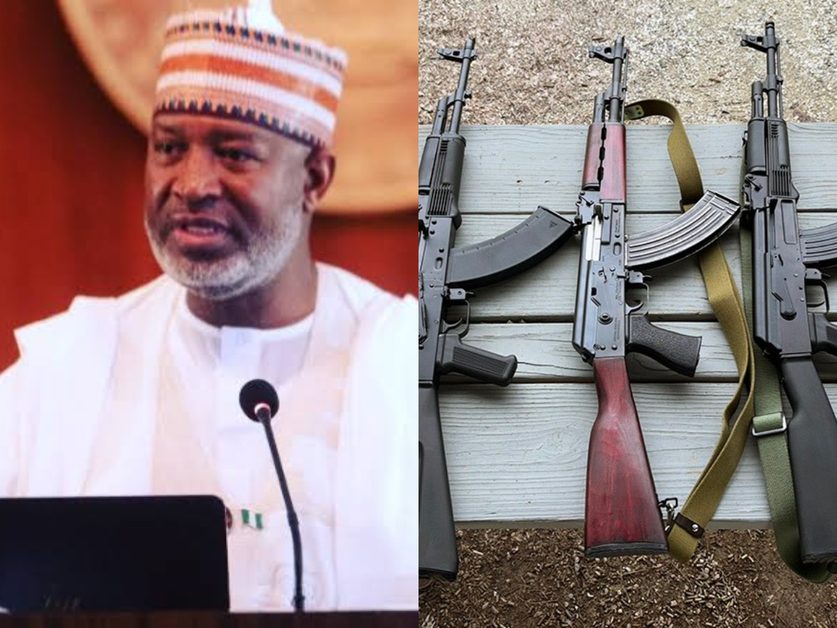
The Federal Ministry of Aviation paid N522.49 million for firearms and ammunition in 2023 under former minister Hadi Sirika, but auditors could not find evidence showing where the weapons ended up, FIJ has gathered.
In the 2024 Auditor General for the Federation’s Annual Report on Non-Compliance/Internal Control Weaknesses in Ministries, Departments and Agencies (MDAs), the auditor said the ministry claimed that one batch of firearms had been supplied to the Department of State Services (NSCDC) for safekeeping and another to the Nigeria Security and Civil Defence Corps (NSCDC) headquarters in Abuja.
But the auditors said there was no evidence that the firearms were in the custody of either agency.
The audit reported that N522.49 million was spent through two separate procurements for firearms and ammunition for aviation security. The first payment was N270.02 million for AK rifles, red-dot sights and AK ammunition.
The second purchase was N252.47 million for sub-machine guns, pistols and ammunition. The auditors also flagged both procurements for not following due procurement processes. Most importantly, the transactions took place in 2023 when Sirika was Minister of Aviation.
N270M GUNS. EVIDENCE OF RECEIPT? POOF!
The auditors said the ministry paid N270,020,066.80 through two payment vouchers dated January 10 and May 23, 2023. The money was for AK rifles, red-dot sights and ammunition.
However, the auditors said they did not find a store receipt voucher confirming that the aviation ministry had received the guns. Per the report, the aviation ministry claimed that the firearms were supplied to the NSCDC for safekeeping because the aviation authority was yet to complete its own armoury.
However, the auditors said there was no evidence showing that the weapons and ammunition were in the custody of the NSCDC. The auditors also flagged the procurement for failing to follow due procurement processes.
The ministry disputed the auditor’s claims. It told the auditors that the procurement had gone through the required procedures and that it had supplied documents it was mandated to supply.
The ministry said it provided award and acceptance letters, Bureau of Public Procurement documents, Federal Executive Council approval, the contract agreement, payment vouchers and security clearance from the Office of the National Security Adviser.
However, this did not convince the auditor. The audit report described the aviation ministry’s response as “unsatisfactory” and maintained that its findings still stand pending the reconciliation of the paperwork and the purchased weapons.
The auditors recommended that the Permanent Secretary should account to the Public Accounts Committees of the National Assembly for the N270.02 million and recover the money for remittance to the Treasury.
ANOTHER N252M PAID FOR FIREARMS WITH NO SHOT AT THE LOCATION
The auditors also flagged another N252,470,282.20 paid for firearms and ammunition for aviation security without following due procurement processes. The payment in question was made through two vouchers dated February 10 and May 23, 2023.
This procurement covered sub-machine guns, pistols and ammunition. Like it did in the first case, the ministry claimed that the firearms had been supplied to the DSS headquarters armoury in Abuja for safekeeping because its own armoury was not ready.
But the auditors said they found no evidence showing that the weapons were in the custody of the NSCDC.
Again, the ministry maintained that the required procedures had been followed and that the necessary approvals had been obtained. It also referred the auditors to a letter from the Director of Finance and Accounts of the Federal Airports Authority of Nigeria dated August 7, 2025, which it said forwarded a delivery note.
The ministry argued that this showed that the contract had been executed. However, this did not convince the auditor. The audit report described the aviation ministry’s responses as “unsatisfactory” and maintained that its findings still stand pending the reconciliation of the paperwork and the purchased weapons.
They recommended that the Permanent Secretary should account to the Public Accounts Committees of the National Assembly for the N270.02 million and recover the money for remittance to the Treasury.
SIRIKA’S OTHER BATTLE WITH THE EFCC
Sirika, who was Minister of Aviation when the firearms purchases were made, is currently standing trial before the Federal Capital Territory High Court in Abuja in a corruption case brought by the Economic and Financial Crimes Commission (EFCC).
Sirika and three others — his daughter, Fatima, his son-in-law, Jalal Hamma, and Al Buraq Global Investment Limited — are facing an amended six-count charge involving alleged contract fraud worth N2.83 billion.
The EFCC said that Sirika used his position to influence the award of a N1.33 billion consultancy contract for the Nigeria Air project to Tianaero Nigeria Limited, whose alter ego the prosecution says was Gabriel Tilmann, his associate.
It also claims that he influenced the award of a N1.50 billion Katsina Airport apron-extension contract to Al Buraq, a company linked to his daughter and son-in-law.
The trial is ongoing.
In June, an EFCC investigator told the court that Sirika bypassed procurement procedures in relation to the Nigeria Air contracts. In July, the court heard an audio recording which the prosecution said contained Sirika giving instructions on a contract award.
However, the defence has challenged the prosecution’s case. In April, the court rejected the extra-judicial statements of Sirika’s daughter and son-in-law after finding that the EFCC had not complied with the relevant legal requirements in obtaining them.
NIGERIA HAS LONG REPORTED PROBLEMS WITH WEAPONS DIVERSION
Nigeria has a documented history of issues with the diversion and illicit circulation of firearms.
The National Small Arms and Light Weapons Survey, conducted by Nigeria’s Presidential Committee on Small Arms and Light Weapons (PRESCOM) with support from the Small Arms Survey, identified “diversion and illicit supply” as key sources of firearms in the country. The survey was conducted in 2016 and published in 2021.
The Small Arms Survey also reported that poor accounting and inadequate physical security of national stockpiles can facilitate the diversion of ammunition to terrorists and other dangerous groups.
In a statement to the United Nations in June, the Nigerian government said it was working to strengthen “marking, record-keeping, tracing and destruction of seized and recovered weapons” and to improve stockpile management and prevent the diversion and illicit circulation of weapons.